
Paint, ink and resin filtration: contaminants, gels and media selection
Distinguish useful pigments from contaminants, then examine gels, viscosity, staged filtration, compatibility, colour changes and trial design.
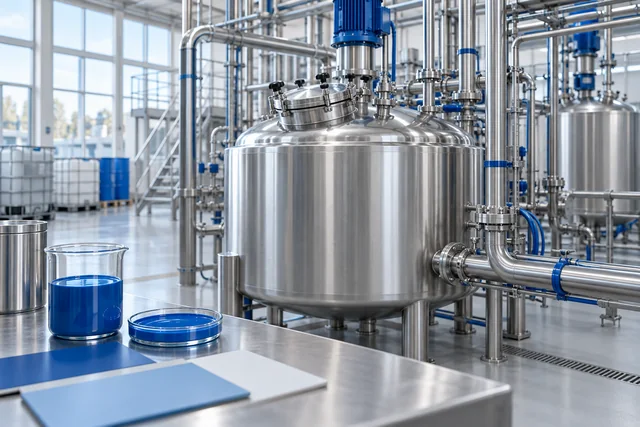
Applications and filtration duties
Paint filtration controls unwanted material while preserving the formulation. Evaluate target contaminants, viscosity and finished-product quality together rather than removing every solid.
Resins, emulsions and adhesives
Gels, skin fragments and foreign particles differ in deformation and adhesion. Rigid-particle data alone may not predict gel behaviour. Observe cake formation, loading and product quality during trials.
Separate clean-fluid resistance from the resistance accumulated during filtration. Area, pretreatment and media construction address different causes. For shear-sensitive formulations, include pumping and mixing conditions in the comparison.
Paints, inks and pigment dispersions
Useful pigment and abnormal agglomerates can overlap in size. Begin with the actual coating or printing defect and examine retained material; a pore-size number alone does not describe the trade-off.
Final filling and recirculation involve different pass counts. Record passes, temperature and differential pressure, then compare product quality and viscosity rather than reporting only initial throughput.
Lubricant blending, transfer and filling
Map receiving, storage, blending, transfer and filling because contamination can enter at different points. Locate filtration around the protected operation and account for batch changeover and product recovery.
Specify viscosity with temperature. Compare bag and cartridge options using rating basis, load, area, pressure drop, batch time and maintenance. Particle filtration alone does not establish water removal or restored oil chemistry.
Solvents and general chemical liquids
Identify particles from incoming liquid, storage or processing and whether temperature or residence time changes them. Clear solvent can still contain particles; colour may be dissolved rather than mechanically filterable.
Review all wetted materials and cleaning fluids. For hazardous duties, the project team must also define area, grounding and equipment requirements; a material grade alone is not a complete design.
Hot, crystallizing and recovered liquids
Crystallization may occur during shutdown as temperature falls or liquid remains stagnant. Include ambient minima, hold time, drainage and startup sequence when reviewing insulation or jackets.
Recovered liquid can vary across a batch. Sample representative stages and assess compressible or sticky deposits before deciding on pretreatment. Evaluate cleaned elements through hydraulic and quality results, not appearance alone.
Formulation and filter configuration
Contaminants, pigments and gels
Paint and ink may intentionally contain pigments, fillers and dispersed ingredients. Fibres, skin fragments and abnormal agglomerates differ from useful formulation particles. Clarity alone is therefore not a suitable acceptance target. Production and quality teams should identify the defect-producing material.
Gels need not behave like rigid spheres. Deformation and adhesion can make a pore-size label an incomplete predictor. Compare defect samples, retained material and acceptable batches before selecting trial media.
Choosing the process position
Post-mixing filtration addresses filterable contamination from ingredients or processing. Transfer filtration depends on batch size and pumping time. A final stage before filling is closer to the finished product, but downstream hoses and containers can still introduce contamination.
Do not assume every line needs three stages. Trace where defects arise; an upstream filter cannot correct contamination introduced later. Map sampling points, recirculation and colour-change drainage before changing the process.
Comparing mesh, depth and pleated media
Mesh openings, depth-media structure and pleated area represent different design approaches. Actual gel and agglomerate control also depends on material and liquid conditions; bag versus cartridge is not a universal coarse-versus-fine distinction.
A trial should measure flow, pressure drop, retained material and finished-product attributes. Changes in colour, gloss, hiding or application behaviour may indicate that useful components were removed. Compare candidates using the same batch where practical.
Viscosity, flux and batch quality
Why viscosity matters
Water-flow data cannot simply be reused for a viscous resin. Viscosity can depend on temperature, formulation, solids and shear conditions. Report units, measurement temperature and test conditions rather than describing a liquid only as thick.
Evaluate the pump, pipework, valves, housing and element together. Additional media area may be considered, but throughput needs application data. Heating is not a universal solution; formulation stability and process safety require review.
Acceptance based on product quality and batch cost
Define production measures such as batch completion time, filtration measures such as pressure-drop history and changeouts, and established quality acceptance criteria. Long element life is not a success if product quality deteriorates; the finest rating is not a goal by itself.
Compare consumables, waste, retained product, cleaning and downtime. Without site data, retain candidates and a trial plan rather than promising a specific rating, area, material or operating envelope.
Applying the principle
Illustrative idealization: for a Newtonian fluid and unchanged clean medium in an approximately linear regime, Δp ∝ μQ/A helps explain viscosity, flow and area. Doubling viscosity may approximately double the medium pressure drop.
This is a trend relationship, not complete equipment sizing. Non-Newtonian behaviour, housing losses and cake growth require applicable curves or trials. Identical connection size and flow do not define an equivalent duty.
Operation and troubleshooting
Compatibility and colour-change cleaning
Compatibility includes the media, supports, bonding materials and seals, not just the metal housing. List process and cleaning fluids separately, with composition, temperature and contact duration, then check documentation or test as needed.
Frequent colour changes also require attention to hold-up, drainage and operator exposure. Reuse must follow the specific element instructions and quality requirements; a visually clean element does not establish restored integrity or acceptable residual contamination.
Diagnosing operating symptoms
Separate low clean-element flow from throughput that decays during a batch. The first points toward viscosity, area, piping and pump duty; the second toward loading and cake development. A batch-specific fault calls for raw-material and process-history review.
Retain before/after samples and residue records. Relate quality to pressure-drop history and include hold-up, colour-change time and rejected product in the cost comparison.
Comparing configurations
Compare process targets, operating constraints and quality requirements together to identify the configuration and trial information needed next.
| Focus | Check | Why it matters |
|---|---|---|
| Formulation preservation | Useful pigment versus unwanted material | Avoids removing useful ingredients |
| Throughput | Viscosity at process temperature, batch and time | Water data are not directly transferable |
| Colour changes | Hold-up, cleaning fluid and service clearance | Affects carryover and batch cost |
Frequently asked questions
Can filtration solve every coating defect?
No. Formulation, substrate cleanliness, air and application conditions can also contribute. Establish whether filterable contamination is involved before changing filtration.
Can an ordinary filter bag remove water from oil?
Do not assume so. Particle capture differs from water separation; distinguish free, emulsified and dissolved water before selecting treatment.
Is a micron rating enough for a quotation?
Fluid, viscosity, flow, pressure, temperature, connections, batches and compatibility are also needed. A rating alone cannot define area, element count or seals.
References
Further reading on filtration principles, process design and test methods. Refer to the relevant product documentation for equipment-specific data.
- Pall · Sealant, Paint and Coatings ↗
Application background for paint-process filtration.
- Pall · Polymer Filtration ↗
Gel and particle-control background; vendor technology is not a claim for our products.
Find a configuration for your process
Start with your fluid, throughput and equipment to discuss housings, elements and maintenance. Drawings, photographs or an existing model are useful starting points.
Related filter housings and elements
Compare housing construction, filter elements and configuration options for your process.
BV Flat-cover Single-bag Filter Housing
A straightforward flat-cover, multi-bolt construction for single-bag filtration with a clear operating sequence and layout choices.
Learn moreNylon Monofilament Filter Bag
The defined monofilament mesh structure suits duties where open flow and particle classification are important.
Learn moreMMS Metal Mesh Filter Cartridge
The metal-mesh construction provides a defined surface-filtration path that can be configured around temperature, pressure, rating and size.
Learn more