
Data-center liquid-cooling filtration: cold plates, coolant and pressure drop
Understand particles in cold-plate loops, distinguish facility and technology circuits, and review rating, flow, pressure allowance, coolant compatibility and servicing.
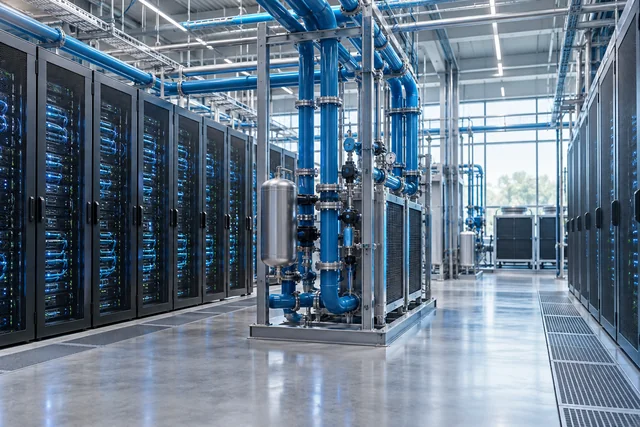
Applications and filtration duties
Liquid-cooling filtration must protect sensitive passages while preserving required circulation. Define the rating from component requirements, coolant, available differential pressure and maintenance—not a finer-is-always-better rule.
CDU and cold-plate operation
In a liquid-to-liquid CDU, facility and technology fluids exchange heat without sharing the same circuit. The pump, manifolds, connectors and cold plates contribute requirements; other CDU architectures differ.
Coordinate filtration with protected components, monitoring and maintenance. Review clean and loaded pressure drop against the full circuit’s flow needs instead of choosing a universal rating first.
Cold-plate and channel flushing
Post-manufacturing or service flushing removes internal residue from cold plates, manifolds and pipes. Its changing load and cleanliness endpoint differ from steady-operation filtration.
Define the object, fluid, direction, flow, sampling and acceptance method. Falling return-particle counts must be interpreted with circuit coverage, including branches. Keep temporary-element changes and reconnection clean to avoid reintroduction.
Coolant formulation and wetted materials
Glycol type alone is not the complete fluid specification. Concentration, additives, temperature and history affect viscosity and material assessment. Review the whole wetted assembly with the coolant requirements.
Water-based cold-plate and immersion duties differ. Evaluate chemical compatibility, retention and material release separately; resistance to a fluid does not establish low release or long-term seal performance.
Particles and pressure-drop trends
Clean and loaded differential pressure describe different operating margins and must specify coolant, temperature and flow. Align replacement with alarms, minimum flow and maintenance windows.
Retention, release and system cleanliness are distinct tests. Use consistent sampling and log flow and temperature with pressure so hydraulic changes are not mistaken for contamination changes.
Energy storage, charging and thermal management
Storage and charging loops may differ from data centers in coolant, ambient conditions, load, space and service. Re-establish the system requirements rather than copying a cooling configuration.
Outdoor or compact equipment also needs cold-start, drainage and service-access review. A compact housing must still allow real element removal and inspection.
Cooling circuits and particle control
Distinguish facility, technology and immersion systems
In a cold-plate system with isolated heat exchange, the facility circuit and the technology circuit serving racks have different duties and may use different fluids. The CDU, cold plates, manifolds and connectors form a coordinated system; “data-center water” is not an adequate duty description.
Immersion cooling has different fluids and contact conditions. Do not reuse a water-based cold-plate selection without review. Identify system type, circuit and protected components first.
Where particles enter the loop
Assembly residue, filling, connections, maintenance and material changes during operation are potential particle sources to investigate. Accumulation at sensitive passages can affect local flow, so location and targets need coordination with the system design.
Filtration does not replace clean assembly, flushing or controlled filling. Commissioning and stable operation may have different loads; do not extrapolate lifetime performance from one short operating condition.
How component requirements inform the rating
The most particle-sensitive component is an important input, whether a cold plate, connector or another passage. A universal multiplier of channel size is not an adequate selection rule; particle shape, rating definition and system validation also matter.
Obtain the component or system supplier’s requirements and clarify the performance basis. Select the rating together with component requirements, pressure budget and loop validation; similar-looking equipment can have different operating capabilities.
Pressure budget and flow requirements
Rating, area and the pressure budget
The filter contributes to loop resistance. Review clean-element pressure drop and its development with loading, confirming that required flow remains available. Finer media without a pressure-budget review may conflict with circulation requirements.
Use the actual coolant concentration and temperature, including startup conditions, rather than room-temperature water alone. The system designer must review the pump and complete circuit; element data alone cannot demonstrate cooling capacity.
Applying the principle
Hypothetical pressure budget, not product data: 80 kPa available at the design point minus 55 kPa for other components leaves 25 kPa for filtration, uncounted losses and margin—not automatically for the filter alone.
Check loaded as well as clean operation with the actual coolant. Element throughput in isolation differs from maintaining the full system’s required flow as loading increases.
Operation and troubleshooting
Coolant formulation, materials and service
Water-based, glycol-containing and other coolants are not interchangeable descriptions. Additives, concentration and temperature affect compatibility. Review housing, media, supports and seals, and follow coolant/system instructions on mixing and maintenance.
Service planning includes shutdown, isolation, drainage, venting, seal checks and restart. An unreviewed bypass is not a default no-shutdown solution; continuity requirements belong in system design.
Diagnosing operating symptoms
Check flow and temperature before interpreting rising pressure drop. Cold viscosity, pump-speed changes and loading call for different responses. Rapid recurrence after replacement suggests continuing contamination; persistently high clean resistance suggests hydraulic sizing.
Separate flushing and operating records. Heavy commissioning residue does not predict steady life, while continuing particles in service call for source and material investigation.
Comparing configurations
Compare process targets, operating constraints and quality requirements together to identify the configuration and trial information needed next.
Inquiry and acceptance information
Prepare the system type and sketch, coolant documentation, flow range, operating conditions, pressure allowance and component particle requirements. Add connections, orientation, clearance and continuity/maintenance needs.
Acceptance should address agreed flow, pressure drop, sealing, cleanliness and service targets using project-defined methods. Confirm each performance and material document. Without application data and tests, a product remains a candidate rather than a qualified system solution.
| Focus | Check | Why it matters |
|---|---|---|
| Circuit boundary | Facility / technology / immersion | Fluids and requirements may differ |
| Sensitive component | Supplier particle criteria and validation | No universal rating |
| Hydraulics and service | Clean/loaded pressure drop and replacement | Balance protection, flow and serviceability |
Frequently asked questions
What micron rating does liquid cooling need?
There is no universal value. Review component criteria, rating definition, coolant and pressure budget together before specifying one.
Does a filter eliminate commissioning flushing?
No. Assembly cleanliness, flushing, filling and filtration are complementary controls. Follow the system commissioning procedure.
Can a cooling-water filter be reused as-is?
Recheck coolant, cleanliness, seals, particles, pressure drop and service needs. Similar application names do not establish suitability.
References
Further reading on filtration principles, process design and test methods. Refer to the relevant product documentation for equipment-specific data.
- Open Compute Project · ACS Liquid Cooling Cold Plate Requirements, Revision 1.0 (2019) ↗
Conceptual background on cold-plate loops, CDUs, materials and filtering; not product certification or a current project specification.
Find a configuration for your process
Start with your fluid, throughput and equipment to discuss housings, elements and maintenance. Drawings, photographs or an existing model are useful starting points.
Related filter housings and elements
Compare housing construction, filter elements and configuration options for your process.
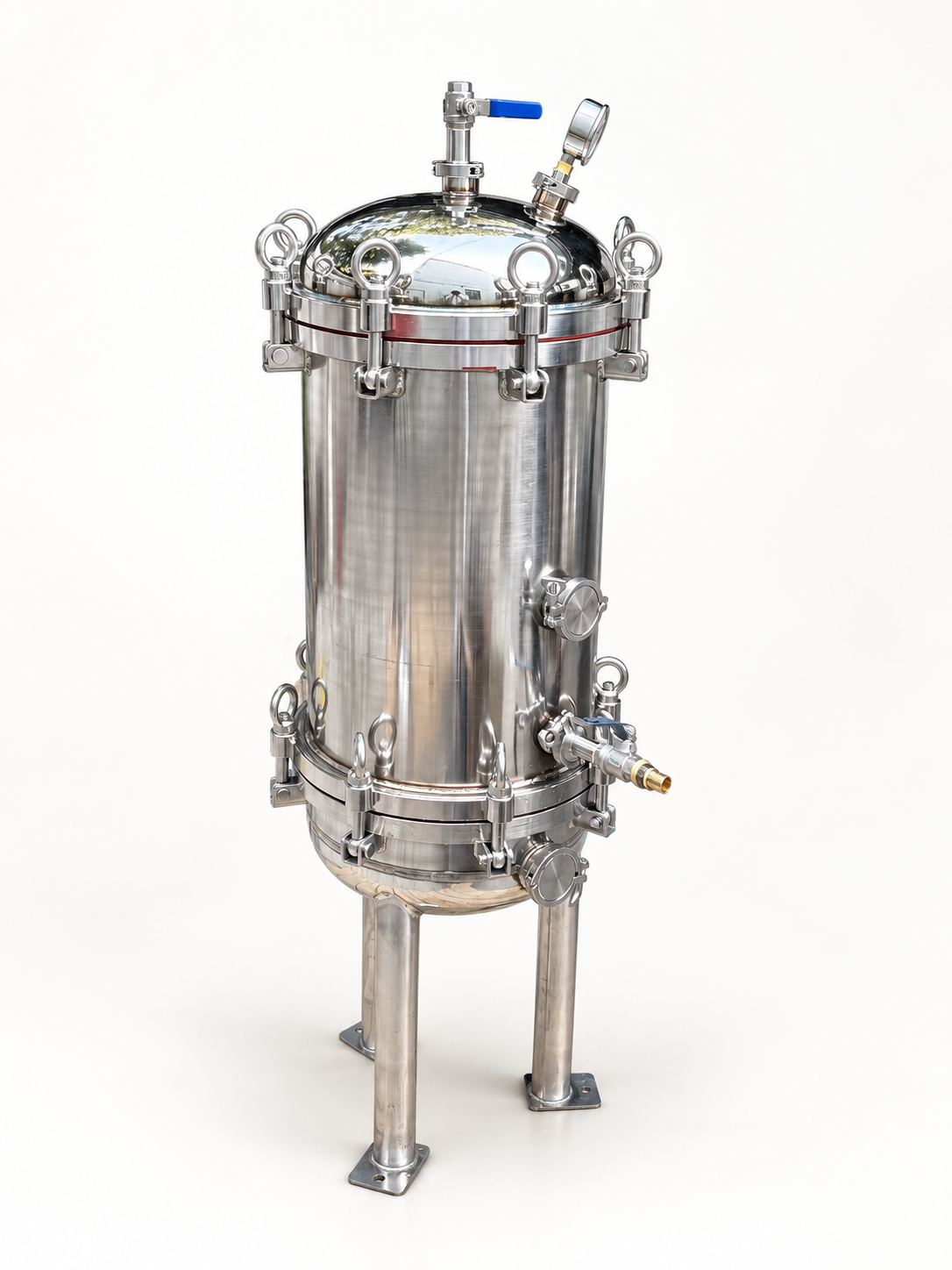
MCV Multi-cartridge Filter Housing
Multiple cartridges in parallel make it easier to scale filtration area and throughput around cartridge count, length and connections.
Learn moreSCV Single-cartridge Filter Housing
A compact single-cartridge housing that can be configured clearly around cartridge length, connections and installation space.
Learn morePP Membrane Pleated Filter Cartridge
The pleated construction provides a larger effective filtration area for liquid duties that balance throughput and particle capture.
Learn more