
Pharma and fine-chemical filtration: compatibility, prefiltration and validation
Distinguish utility liquids, intermediates and critical product-contact steps. Review particulate prefiltration, sterilizing-filter boundaries, compatibility, adsorption and validation evidence.
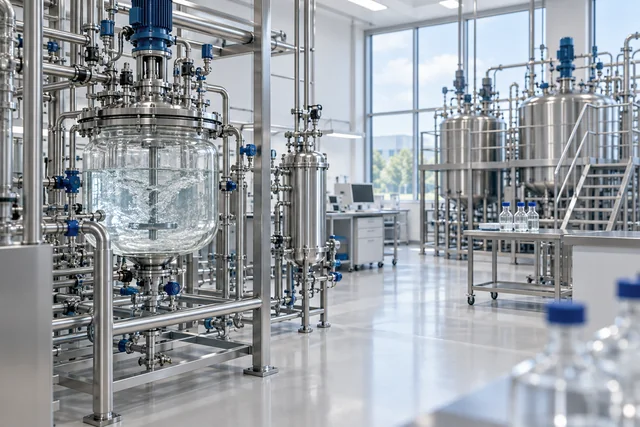
Applications and filtration duties
Selection starts with process duty and quality risk. Particulate prefiltration, bioburden control and validated sterilizing filtration are distinct duties requiring different evidence.
Raw materials and intermediates
The same solvent can have different duties at receipt, intermediate transfer and a critical contact step. Identify the stage and next operation before setting particle, material and record requirements.
Intermediate composition can change with temperature and time. Record sample timing and storage, and distinguish particle removal from composition changes. Yield and stability matter alongside contaminant removal.
Extracts, decolorization and clarification
Extracts can contain coarse residue, fines, colloids and dissolved components. Allocate bulk separation and polishing according to solids load and product goals.
After activated-carbon treatment, adsorption and carbon-particle capture are separate duties. Evaluate startup breakthrough, loaded operation and differential pressure rather than one clear sample, and consider staged treatment where appropriate.
Cosmetics and personal-care liquids
Toners, fragrance solutions, wash liquids and creams have different structures. Lower-viscosity liquids may be assessed for debris and undissolved material; emulsions and creams have useful dispersed structures and more complex flow behaviour.
Compare appearance, stability, viscosity and ingredient retention as well as throughput. Test the real formulation and cleaning fluids, with attention to hold-up and formula-changeover carryover.
Utility water and support liquids
Cooling, cleaning, utility water and product-contact liquid need duty-specific controls. Equipment protection and direct product contact call for different evidence even on neighbouring lines.
Recirculated cleaning liquid also needs concentration, residue and carryover management. Particle removal can address part of the suspended load; reuse requires defined monitoring, replenishment and replacement conditions.
Hygienic construction and validation
Hygienic design addresses drainage, cleanability, hold-up and controlled assembly. Retention performance addresses the target contaminant under stated conditions; one material certificate cannot answer both.
Sterilizing filtration needs process-specific validation and applicable integrity controls. FDA aseptic-processing guidance discusses these in its drug-manufacturing context, not as a generic certification of ordinary filters.
Filtration duties and wetted materials
Define the duty before the product
Utility liquids may support cooling or cleaning, while process liquids can be ingredients, intermediates or final product. Product contact, process stage and downstream controls determine different material, cleanliness and documentation needs. Different lines in one facility are not automatically equivalent.
Start with a user-requirement brief: fluid composition, quality target, operating mode, validation needs and consequences of failure. Define the required result before choosing construction.
Prefiltration versus a critical filtration step
Particulate prefiltration may protect a downstream process and is assessed through particle loading, flow and differential pressure. A critical product step may have additional quality, microbial or validation targets; successful prefiltration does not establish their achievement.
A micron label alone does not make an element sterilizing grade. Such a claim needs use-specific performance and validation evidence. The products linked here are discussion candidates, with documents and suitability subject to review.
Compatibility across the wetted assembly
Fine-chemical liquids may contain solvents, acids, bases or mixtures. Review concentration, temperature range, contact duration, cleaning fluids and composition changes. A single-chemical compatibility chart may not cover a mixture.
Include membranes or fibres, end caps, supports, bonding materials and seals as well as the housing. Request applicable material information and determine whether exposure or actual-fluid testing is needed. Unknown composition cannot be replaced by a guess about common materials.
Product quality and validation design
Adsorption, extractables and leachables
Filtration can involve interactions beyond particle capture. Fluid components may interact with contact materials, so loss of useful ingredients or material-derived substances may need assessment according to process risk. Appearance cannot establish this.
List compatibility, composition retention, extractables and use-condition leachables separately. Supplier information is an input, not a completed validation of the user’s formulation. The responsible team should define tests for critical quality attributes.
Applying the principle
Illustrative toner-line assessment: sample the bulk liquid, tank outlet and pre-filling point to locate contamination. Compare media on the same batch for throughput, pressure drop, appearance and composition, then assess hold-up and changeover cleaning.
Contamination from downstream hoses needs source control; agglomeration after mixing may require upstream process changes. Equipment labels alone do not identify the appropriate intervention.
Operation and troubleshooting
Cleaning, integrity and traceable records
Cleaning or sterilization must stay within the confirmed equipment and element envelope. Integrity-test method and acceptance criteria must come from the specific product and validation plan; a general leak check is not proof of retention performance.
Record batches, installation, throughput, conditions, replacement reasons and deviations. For critical duties, element, material or supplier changes belong in the project’s change-control process, not merely a dimensional comparison.
Diagnosing operating symptoms
Fines downstream may reflect media retention, seal bypass or downstream contamination. Match inlet/outlet sampling times and check assembly. If yield or concentration changes, examine adsorption, hold-up and composition effects.
Keep compatibility, retention, integrity and ingredient-preservation results separate for diagnosis and supplier comparison. Use established change procedures for critical processes.
Comparing configurations
Compare process targets, operating constraints and quality requirements together to identify the configuration and trial information needed next.
Building the inquiry document pack
Include a process sketch, process and cleaning fluids, flow, operating conditions, quality target and installation constraints. Separately list material records, traceability, validation support and delivery documentation; mark unknowns explicitly.
Separate mandatory requirements from discussion points before assessing candidates. An industry label does not demonstrate pharmaceutical certification or customer validation. Keep documentation gaps visible for review.
| Focus | Check | Why it matters |
|---|---|---|
| Process role | Utility / intermediate / critical product contact | Different duties need different evidence |
| Material assessment | Composition, concentration, temperature, time | Housing material alone is insufficient |
| Quality validation | Methods, documents and change controls | Generic data do not validate the actual process |
Frequently asked questions
Does 0.22 μm automatically mean sterilizing grade?
No. The label does not prove sterilizing performance; applicable performance evidence, compatibility and process validation are needed.
Can a candidate directly replace an existing brand?
Compare fit, seals, materials, performance methods and documents. Critical applications also require the user’s change-control and validation review.
Are material certificates the same as validation?
No. A certificate addresses specified materials or batches; validation establishes whether the defined process goal is achieved under intended use conditions.
References
Further reading on filtration principles, process design and test methods. Refer to the relevant product documentation for equipment-specific data.
- Merck · Single-Use and Filter Validation Services ↗
Framework for compatibility, extractables/leachables and filtration validation.
Find a configuration for your process
Start with your fluid, throughput and equipment to discuss housings, elements and maintenance. Drawings, photographs or an existing model are useful starting points.
Related filter housings and elements
Compare housing construction, filter elements and configuration options for your process.
SCV Single-cartridge Filter Housing
A compact single-cartridge housing that can be configured clearly around cartridge length, connections and installation space.
Learn morePP Membrane Pleated Filter Cartridge
The pleated construction provides a larger effective filtration area for liquid duties that balance throughput and particle capture.
Learn moreMPS Sintered Metal Powder Filter Cartridge
A stable sintered-metal porous structure with uniform pores, selected around rating, dimensions, temperature and pressure.
Learn more