
Liquid filtration for electronics: particles, cleanliness and wet processes
Explore contamination in cleaning, rinsing and wet-process loops. Distinguish particles, metals and organics, and review cleanliness, material release, sampling and replacement.
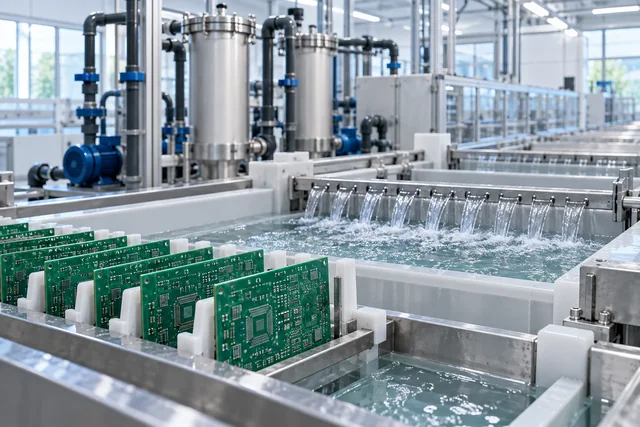
Applications and filtration duties
Cleanliness combines several measures. Particles, metal ions, organics and material release are distinct issues; particulate retention alone does not establish high-purity or semiconductor suitability.
PCB wet processing
Cleaning, rinsing and chemical baths have different compositions and particle sources. Associate defects with the process step before selecting circulation, use-point or transfer filtration.
Distinguish useful chemistry from contamination. Evaluate media, housing and seals at actual conditions, and connect fluid measurements to board or process acceptance results.
Precision parts and optical cleaning
Part cleanliness is an outcome; fluid particles are a process measure. Cleaning, rinsing, drying and handling connect the two. Define the part acceptance and sampling method first.
Optical particles and organic residue require different assessment. Keep washing and handling conditions stable to distinguish filtration effects from other process changes.
Photovoltaic and wafer-related liquids
Wafer cleaning, process recirculation and utility water are different duties. Identify the chemical composition, protected surface and any dispersed ingredients that must remain.
Map make-up, bath, use and return points against defects. Where low release or high cleanliness is required, assess the element and complete wetted path with the specified methods.
Battery materials and cell-process liquids
Electrode slurry contains functional solids. Filtration targets abnormal agglomerates or foreign material while preserving the formulation; size overlap, rheology and shear sensitivity complicate selection.
Support cleaning liquids and utilities have different duties. Trials should record dispersion, viscosity, throughput, residue and downstream quality, especially under loading rather than only initial clean flow.
Electronic chemicals and semiconductor utilities
Utility prefiltration and core electronic processes can have very different particle, metal, organic and release requirements. A particle test answers only its defined question; obtain use-point criteria first.
Clean packaging, installation and rinse-up contribute to system performance. Compare fit, materials, methods and startup behaviour with consistent sampling across candidates and batches.
Contamination and wetted paths
Trace defects back to the fluid path
Residual particles may come from fresh liquid, tanks, piping, parts or maintenance. Record the process step, timing and batch, then ask whether sampling represents the point of use. A tank sample may not describe what reaches the workpiece.
Map make-up, use, return and drain paths with pumps, valves, hoses and sampling ports. Contamination introduced after the filter calls for downstream material and handling controls, not simply a finer element.
Particles, ions and organics are different targets
Particle filtration addresses suspended contaminants under defined conditions. Metal ions and dissolved organics require different measurements and control strategies. A transparent liquid does not demonstrate that all cleanliness targets have been met.
Provide defect-related quality criteria and methods, then define the filter’s role. High-purity or semiconductor wet-process use needs separate evidence for material cleanliness, release and validation. The electronics label covers widely differing requirements.
Chemical compatibility throughout the loop
Composition, concentration, temperature and additives influence material selection. Review housing, media, ends, seals and connections as an assembly. One suitable component does not qualify the entire loop for the same chemical or cleanliness requirement.
Process changes also introduce rinse and carryover questions. Supply the fluid list and operating sequence. Without evidence for the specific fluid, materials remain candidates rather than a promise of universal chemical or ultrapure compatibility.
Cleanliness metrics and sampling
Looking beyond the micron label
Identical nominal ratings can reflect different test fluids, efficiencies and methods; they do not predict every particle in a process chemical. Initial particle release, rinse-up and wetted materials may also affect startup cleanliness.
Compare rating definitions, test conditions, hydraulic data, seals and clean-delivery requirements. Replacement in a qualified process requires evaluation of both startup and steady operation using the user’s method, not dimensions alone.
Sampling without confusing the result
Containers, ports and sampling technique can affect particle results. Inconsistent methods make it difficult to separate filter effects from sample handling. Use project-defined locations, flushing and repeat measurements while recording conditions.
Observe both fluid results and production quality. If defects persist, revisit the contamination source and measurement relevance rather than continually selecting finer media. Consistent comparisons are more useful than one favourable reading.
Applying the principle
Illustrative sampling plan: compare filter inlet, outlet and point of use with consistent containers, flushing and methods at similar conditions. Inlet-to-outlet shows the filtration step; outlet-to-use helps identify downstream contamination.
A rise only at use points directs attention downstream. Large variation everywhere calls for sampling and upstream-process review. The process defines the actual limits and test methods.
Operation and troubleshooting
Maintenance and supplier evidence
Handling particles, incorrect seals and unsuitable rinsing can affect the outlet condition. Follow site procedures for unpacking, installation, flushing and release to production, with element batch and deviation records. Quality requirements define the rinse endpoint.
An inquiry should include fluid, targets, flow, temperature, pressure allowance, connections and specific release or extractables documentation. Product references are starting points; electronic-grade or high-purity suitability needs separate confirmation.
Diagnosing operating symptoms
First identify what each metric measures: particles, conductivity, metals and organics answer different questions. After replacement, investigate handling, release, rinsing, seals and sample containers. Unchanged defects despite stable particle counts call for a renewed cause review.
Record location, container, preparation, method and production timing so operating changes are not mistaken for media differences.
Comparing configurations
Compare process targets, operating constraints and quality requirements together to identify the configuration and trial information needed next.
| Focus | Check | Why it matters |
|---|---|---|
| Particles | Count, size and measurement conditions | Separate from ionic contamination |
| Wetted materials | Compatibility and release criteria | Evaluate the complete assembly |
| Trial result | Point-of-use sampling and defects | Connect measurements to the actual goal |
Frequently asked questions
Does submicron filtration mean electronic grade?
No. Cleanliness, release, materials, packaging and validation have separate requirements defined by the application.
Will a particle filter lower conductivity?
Not as a general claim. Conductivity relates to ions, and ordinary particle capture is not a substitute for dissolved-ion treatment.
Why can particles rise after replacement?
Check handling, initial rinsing, element release, seals and sampling. Investigate under site procedures rather than assuming finer media will solve it.
References
Further reading on filtration principles, process design and test methods. Refer to the relevant product documentation for equipment-specific data.
- Pall · Microelectronics ↗
Background on particles, metals and organics; other suppliers’ capabilities are not StrongFilter claims.
Find a configuration for your process
Start with your fluid, throughput and equipment to discuss housings, elements and maintenance. Drawings, photographs or an existing model are useful starting points.
Related filter housings and elements
Compare housing construction, filter elements and configuration options for your process.
PCV Plastic Cartridge Filter Housing
A compact PP single-cartridge housing for lower-flow liquid duties, configured around length, connections and seals.
Learn morePP Membrane Pleated Filter Cartridge
The pleated construction provides a larger effective filtration area for liquid duties that balance throughput and particle capture.
Learn moreCM PP Melt-blown Filter Cartridge
A gradient-density structure captures contaminants progressively from outside to inside while balancing flow and dirt-holding capacity.
Learn more