
Food and beverage liquid filtration: clarification, water and hygiene
Explore ingredient, process-water and product-liquid filtration. Separate clarification from microbial control and review contact materials, cleaning and validation evidence.
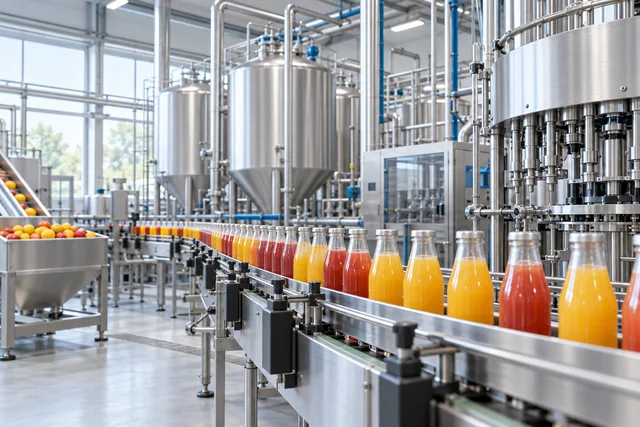
Applications and filtration duties
Define the liquid use and quality target first. Clear appearance does not demonstrate microbiological safety, and a material name is not evidence of suitability for food contact under the intended conditions.
Ingredient and beverage water
Plant inlet water and water added to the product have different duties. Map storage, distribution and use points to identify contamination after pretreatment.
Particle filtration is one treatment stage. Hardness, dissolved salts and other recipe-relevant properties need their own measurements and controls. Define what the selected filter controls and what happens downstream.
Juice, tea and plant-based beverages
Pulp, fibres and suspended components may be desired or unwanted. Pulp-containing and clarified juices require different targets. Compare screening, bags, depth media or other separation methods only after defining the product character.
Soft fibres can deform and build a cake. Record batch throughput, established quality measurements and retained product characteristics; a smaller opening can change both capacity and composition.
Sugar syrups and viscous ingredients
Undissolved sugar and foreign debris are different problems. Review dissolution conditions before assigning all solids to the filter.
Record concentration, operating temperature and shutdown cooling because viscosity changes with them. Batch time defines average throughput; area also depends on resistance and loading. Trials need concentration, temperature and total batch data for meaningful scale-up.
Edible oils and liquid seasonings
Define particulate targets before filling without assuming every suspended component is unwanted. Product standards determine whether flavour- or appearance-related components should remain.
Compare hold-up, drainage, changeover and cleaning as well as throughput at actual temperature. Contact-material requirements cover seals and elements, not only the housing.
Wine, beer and fermented beverages
Separate clarification, prefiltration and microbial-control objectives. Prefiltration may reduce downstream load, while clarification concerns product appearance and stability. Microbial targets require their own process and test plan.
Assess suspended material, downstream pressure-drop development and batch yield together. If prefilters change frequently without helping the final stage, reassess target particles and process arrangement.
Product character and separation targets
Ingredients, process water and finished liquids
Ingredient filtration, process-water treatment and finished-liquid filtration serve different duties. Water quality depends on use, while finished-product acceptance may include appearance and intended product characteristics. “Food application” is not a complete specification.
Map heating, mixing, storage and filling around the filter. Downstream pipes and tanks remain part of the quality-control chain; a successful filtration step does not establish control of everything that follows.
Clarification without losing product character
Clarification concerns suspended material, but some products intentionally retain pulp, suspended components or haze. Product requirements—not the filter supplier alone—must define the desired appearance. Compare before-and-after samples using established quality methods.
High particle loads may justify pretreatment or staging. Each additional contact stage also adds hold-up, cleaning and potential loss. Measure retained product characteristics and consistency as well as flow.
Why clarification is not sterilizing filtration
Microbial control depends on demonstrated element performance, the fluid, operating conditions and process validation—not a pore-size label alone. Clarification, bioburden reduction and a validated sterilizing process are different claims.
For a microbial target, the responsible quality and process teams should define acceptance, upstream/downstream controls and evidence before selecting a system. Product links here support an initial discussion and do not certify a food-safety or sterilizing outcome.
Hygiene and process validation
Checking contact materials and hygienic design
Review the entire wetted path: housing, media, end caps, supports, seals and connections. Documentation must match the liquid, contact duration and temperature. Stainless steel, polypropylene or a polished appearance alone does not establish suitability.
Drainability, cleaning access, assembly and seal design also matter. Share your material requirements and documentation list, then confirm each deliverable. Unverified certificates or validation records remain unconfirmed.
Moving from a sample trial to production
Begin with representative fluid and quality measurements, then assess target flow, batch time and pressure-drop development. Include realistic differences in ingredients, temperature and particle load rather than only the easiest batch.
Record yield loss, changeouts and cleaning alongside quality. Before scaling, agree connections, space, material documentation and responsibility for process review. General principles do not demonstrate that a particular device has passed validation.
Applying the principle
Illustrative trial: use representative portions of one batch at the same temperature and similar flow per media area. Record throughput, differential pressure, product loss and quality, then inspect residue.
Scale-up changes piping, pumping, total solids and residence time. A small trial narrows candidates and identifies production checks; it does not establish an annual replacement schedule.
Operation and troubleshooting
Cleaning, CIP and element replacement
CIP means cleaning an installed system. Suitability depends on chemical composition, concentration, temperature, duration, flow path and construction. A temperature limit alone does not validate a cleaning cycle or establish steam-sterilization compatibility.
Replacement planning includes isolation, drainage, hygienic handling and checks after assembly. Reusable and single-use elements need different procedures. Maintain cleaning, batch and replacement records according to the approved process.
Diagnosing operating symptoms
For juice that starts well then slows rapidly, inspect soft fibres and compressible cake. Low throughput from the beginning points more toward viscosity, temperature, area or flow path. Consider suitable upstream separation before increasing pressure.
If clarification changes product character, evaluate retained components and established quality criteria in the same trial. Removal and preservation are both acceptance goals.
Comparing configurations
Compare process targets, operating constraints and quality requirements together to identify the configuration and trial information needed next.
| Focus | Check | Why it matters |
|---|---|---|
| Clarification target | Haze, suspended components and desired character | Product specification defines the endpoint |
| Hygiene | Contact materials and cleaning cycle | Material names are not evidence |
| Microbial target | Define validation and measurement | Clarity is not sterilization |
Frequently asked questions
Does a clear beverage prove successful filtration?
It describes only part of the appearance result. Check the required product-quality and microbial criteria; visual inspection cannot replace testing.
Is every stainless housing food grade?
No. Review the actual materials, surfaces, construction, seals, conditions and documents for the supplied configuration.
Can a cleaned element be reused indefinitely?
No. Cleanability, reuse limits and rejection criteria follow the element instructions, validated process and quality requirements.
References
Further reading on filtration principles, process design and test methods. Refer to the relevant product documentation for equipment-specific data.
- Pall · Food and Beverage Filtration ↗
Background on ingredients, water and product-liquid applications.
- Merck · Filter Validation Services ↗
Validation and compatibility concepts; not validation of products on this site.
Find a configuration for your process
Start with your fluid, throughput and equipment to discuss housings, elements and maintenance. Drawings, photographs or an existing model are useful starting points.
Related filter housings and elements
Compare housing construction, filter elements and configuration options for your process.
SCV Single-cartridge Filter Housing
A compact single-cartridge housing that can be configured clearly around cartridge length, connections and installation space.
Learn morePP Membrane Pleated Filter Cartridge
The pleated construction provides a larger effective filtration area for liquid duties that balance throughput and particle capture.
Learn morePolypropylene Filter Bag
A lightweight polypropylene-fiber bag suited to prefiltration and particle capture across a range of general liquid duties.
Learn more