
Industrial cleaning and process-liquid filtration: a practical guide
Understand particle control in wash loops, liquid transfer and equipment protection, with guidance on filter media, pressure drop, maintenance and inquiry preparation.
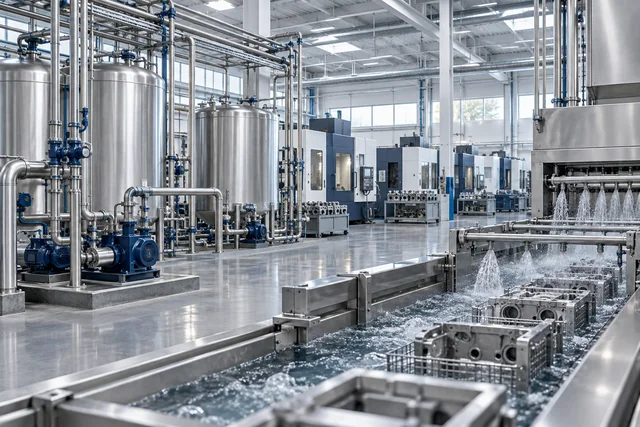
Applications and filtration duties
Start with the contaminant and the equipment or surface to protect. Distinguish solid particles, free oil and dissolved substances before choosing a filter; the label “wash fluid” alone is insufficient.
Machining and grinding fluids
Machining introduces chips and abrasive fines with different separation needs. Suitable screening, settling or magnetic separation can remove part of the upstream load before finer filtration. Magnetic separation addresses ferromagnetic material, not every contaminant.
Frequent bag changes call for a review of solids input, upstream separation and sticky deposits. Useful emulsion and tramp oil are different targets; particle removal alone does not restore fluid concentration or biological stability.
Parts and ultrasonic cleaning
Cleaning detaches contamination; recirculation filtration reduces its return to the point of use. Ultrasonic action, chemistry, temperature, loading and rinsing also affect the part result. Keep these conditions comparable during a trial.
Review return locations, settled zones, pump suction and spray points. A convenient sampling point can miss local deposits or short-circuit circulation. Trace both the part and liquid paths when locating the filter.
Metal finishing baths and rinses
Degreasing, plating and rinse duties differ. Degreasing receives oil and particles; plating also depends on bath chemistry and additives; rinsing receives carryover. Similar flow and connections do not imply identical media or seals.
Assess bath particles, surface preparation and defect patterns together. Dissolved contamination and chemistry imbalance need different evidence from particulate problems. Control maintenance and rinse carryover to preserve the bath.
Nozzle, pump and transfer protection
Nozzle passages and contaminant shape both matter: fibres do not behave like spherical test particles. Combine component requirements with particle data and pressure allowance when comparing strainers, bags and cartridges.
Pump-side placement needs a circuit review. Added suction resistance can affect supply, particularly with viscous liquid or low tank level. Plan pressure measurement, isolation and service access before changing hardware.
Pipe flushing and retrofits
Commissioning can release a concentrated residue load unlike steady production. Plan temporary-element loading, sampling and replacement together with flushing flow, circuit coverage and cleanliness acceptance.
For retrofits, record elements, connections, flow direction and access. Deposits and seal marks on the old element can be informative. Monitor whether contamination is being removed progressively or is still generated within the system.
Process routes and filtration methods
What particle filtration can and cannot do
Metal chips, abrasive debris and fibres can recirculate with a wash fluid. A filter passes liquid while retaining particles according to its demonstrated performance. Objectives may include nozzle protection, reducing redeposition on parts or protecting a downstream stage.
Dark colour, odour or reduced cleaning power may have other causes. Free oil, emulsified oil, dissolved salts and detergent concentration require separate assessment. A particulate filter is not a universal oil separator or chemical regeneration system.
Full-flow, side-stream and transfer filtration
Full-flow filtration treats all liquid in a selected line, so its resistance affects that line directly. Side-stream filtration treats a portion of a circulating volume over time; it does not mean every pass through the process is filtered.
Transfer filtration serves a batch moving between vessels or process steps. State batch volume and the allowed transfer window. A sketch of tanks, pumps, filters and return lines is often more useful than an isolated flow figure.
Comparing bags, depth and pleated elements
Bag and cartridge describe construction, not a guaranteed performance class. Mesh, depth and pleated media differ in capture mechanism, area and loading behaviour. Identical micron labels may conceal different test methods or retention efficiencies.
Compare rating definitions, test conditions, pressure-drop data and compatibility. Staged filtration can be evaluated for mixed particle loads, but each stage also adds resistance, consumables and maintenance; confirm its value with operating data.
Pressure drop, throughput and trials
Pressure and differential pressure
Operating pressure describes the pressure environment; differential pressure is the difference across the filter. Record clean-element differential pressure at known flow and temperature, then compare under similar conditions. Cold-start viscosity or a flow change can alter the reading.
A rising trend calls for checks of loading, area and flow. A sudden fall may reflect lower flow, bypass or an element/seal problem rather than cleaner liquid. Follow equipment isolation and depressurization procedures before opening.
Evaluating a trial with useful measurements
Use consistent sampling locations, production conditions and measurement methods. Log volume treated, flow, temperature, pressure-drop trends and why elements were changed. Add the relevant outcome, such as nozzle blockage or particles on cleaned parts; dark media alone do not measure efficiency.
Compare consumables, downtime, cleaning, waste liquid and labour per completed duty. A successful short run does not establish long-term service life, especially when raw materials or production batches vary.
Applying the principle
Illustrative calculation, not project data: transferring 3 m³ in 30 minutes requires an average 6 m³/h. This defines takt demand, not pump head, media area or element count.
Check resistance at the real temperature and viscosity, with loading allowance. If recirculation also passes through the filter, gross filter flow differs from net tank transfer; measurement must distinguish them.
Operation and troubleshooting
Diagnosing operating symptoms
Use the pressure-drop trend diagnostically. High clean-element resistance suggests flow, viscosity, area or installation checks. Rapid loading suggests solids or upstream separation. Poor part cleanliness with low resistance suggests bypass, downstream contamination or sampling.
Log conditions, throughput, changeout reasons and part results together. Compare elements consumed per unit throughput and downtime per change, not purchase price alone.
Comparing configurations
Compare process targets, operating constraints and quality requirements together to identify the configuration and trial information needed next.
Preparing a useful engineering inquiry
Provide fluid composition, concentration, operating and cleaning temperatures, and viscosity if available. Include contaminant samples or photographs, particle measurements and when faults occur. Add normal/peak flow, inlet/outlet pressure, allowed differential pressure, connections and access.
Define the outcome: less downtime, cleaner parts or protection of the next stage. For replacement, provide the nameplate, element ends and seals. Mark missing data as unconfirmed; appearance alone does not establish interchangeability.
| Focus | Check | Why it matters |
|---|---|---|
| Particle issue | Size distribution, shape and load | Defines the target beyond appearance |
| Hydraulics | Flow, temperature and clean differential pressure | Separates loading from operating changes |
| Element fit | Ends, length, seals and flow direction | Similar size does not ensure sealing |
Frequently asked questions
Is finer filtration always better?
Not necessarily. Finer media may increase resistance and changeouts while the actual problem is oil or detergent concentration. Compare candidates against part acceptance and fluid measurements.
Why is pressure drop high with a new element?
Check flow, cold-fluid viscosity, area, installation direction and valve positions. Do not simply increase pump pressure or confuse a changeout limit with the housing pressure rating.
How often should elements be changed?
Use element instructions, differential pressure, filtrate quality and process maintenance requirements. A fixed number of days is unreliable without throughput and loading data.
References
Further reading on filtration principles, process design and test methods. Refer to the relevant product documentation for equipment-specific data.
- Pall · Automotive Parts Washing ↗
Wash-fluid application background; vendor performance is not a StrongFilter claim.
- Donaldson · Filter Performance & Energy Savings ↗
Background on differential pressure and system resistance.
Find a configuration for your process
Start with your fluid, throughput and equipment to discuss housings, elements and maintenance. Drawings, photographs or an existing model are useful starting points.
Related filter housings and elements
Compare housing construction, filter elements and configuration options for your process.
BV Flat-cover Single-bag Filter Housing
A straightforward flat-cover, multi-bolt construction for single-bag filtration with a clear operating sequence and layout choices.
Learn morePolypropylene Filter Bag
A lightweight polypropylene-fiber bag suited to prefiltration and particle capture across a range of general liquid duties.
Learn moreCM PP Melt-blown Filter Cartridge
A gradient-density structure captures contaminants progressively from outside to inside while balancing flow and dirt-holding capacity.
Learn more