
Water filtration explained: pretreatment, side-streams and membrane protection
Distinguish suspended solids, dissolved salts and microbes. Understand side-stream filtration, membrane guard filters, staging, differential pressure and selection data.
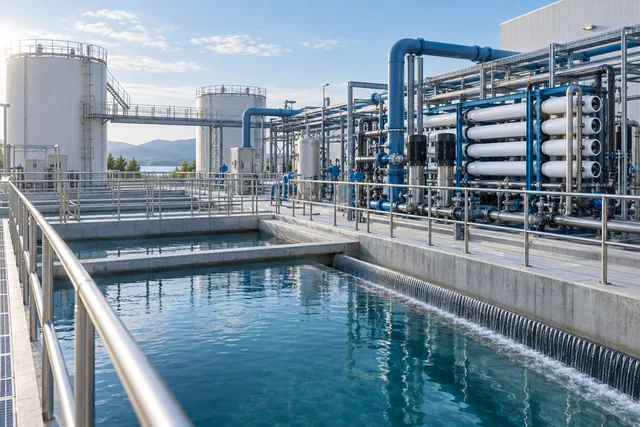
Applications and filtration duties
Particulate filtration addresses retainable suspended contaminants. It can be one treatment stage, but it does not automatically provide desalination, softening, disinfection or removal of all dissolved pollutants.
Raw-water pretreatment
Raw-water loads vary with source, storage and upstream operation. Use representative normal and higher-load samples, then allocate pretreatment and finer filtration around downstream needs.
Adding final cartridges may reduce replacement frequency without being the best response to heavy sediment. Compare pretreatment performance, differential pressure and consumables as a system.
RO, UF and guard filtration
RO, UF and conventional particulate elements have different separation duties. RO is a pressure-driven membrane process; guard elements address a defined particulate protection role. Follow the actual membrane system’s feed and operating requirements.
Rapid guard-filter loading calls for upstream and feedwater review. Poor filtrate with little pressure change also calls for seal and sampling checks. Align acceptance with downstream feed conditions.
Cooling water and closed loops
Full-flow filtration acts on one complete flow path and its pressure budget; side-stream filtration treats part of the system over time. Choose around immediate component protection and bulk cleanliness goals.
Closed loops can contain installation residue or maintenance-related particles even when visually clear. Assess volume, mixing, take-off/return and service windows alongside separate water-chemistry management.
Reuse and industrial wash water
Reuse quality is defined by the next duty: coarse washing and precision rinsing may have very different targets. Clear appearance is not a universal reuse criterion.
Consider suitable upstream separation, waste streams and cleaning needs. Track quality through repeated reuse cycles to identify accumulation that particle filtration does not control.
Continuous supply and high-flow upgrades
Continuous supply requires a defined path during replacement, with flow and quality maintained through changeover. Review valves, venting, drainage and operating sequence; an unassessed bypass changes filtration coverage.
Compare multi-bag and high-flow cartridge systems through rating, area, element count and service access. Include element removal and handling space in installation drawings, not only the housing footprint.
Water quality and system configuration
Turn “dirty water” into measurable targets
Sand, suspended particles, colour, hardness, conductivity and microbes are different observations or measurements. Improving one does not establish compliance with the others. Define the source, use, existing treatment and water-quality target first.
Nozzle blockage may require particle assessment, while scale also involves chemistry and operating conditions. Selecting fine media from a photograph can overlook high upstream loads or dissolved contamination; review the entire treatment train.
Pretreatment and staged filtration
High or variable sediment loads can cause frequent changes if the final fine element carries the entire duty. Settling, suitable pretreatment or a coarser stage may be evaluated before polishing, based on water samples and site conditions.
Staging distributes load; more stages are not automatically better. Compare outlet quality, combined resistance, consumables, waste discharge and maintenance space before adding equipment.
Side-stream versus full-flow filtration
A side stream filters a portion of recirculating water and returns it to the system. This differs from passing all flow in a selected line through a filter. Results depend on contamination input, mixing, take-off/return positions, capacity and operating time.
Total circulation flow alone cannot set the side-stream duty. Include system volume, make-up, discharge, solids and goals. Particle removal does not replace the site’s water-chemistry or microbiological management.
The role of a membrane guard filter
A particulate guard filter between pretreatment and membrane equipment controls part of the incoming particle risk. It does not replace the whole pretreatment system or eliminate every fouling mechanism. Dissolved substances, colloids, microbes and chemical conditions can also matter.
Choose the element against actual water data and membrane-system requirements, not a universal default. Supply upstream treatment details, quality data, flow and the membrane supplier’s feed requirements.
Treatment capacity and circulation
Applying the principle
Ideal mixing example: a 20 m³ system with 2 m³/h side flow has a volume/flow time of 10 h; this does not mean every drop has passed once.
With no new contamination, constant volume and efficiency, and perfect mixing, C(t)=C₀ exp(-ηQt/V). At ideal η=1, one time constant leaves about 37% of the starting concentration. Real contamination and mixing invalidate any direct guarantee from this model.
Operation and troubleshooting
Differential pressure, replacement and discharge
Record clean-element differential pressure at normal flow and track it against throughput. Loading, flow and temperature can all affect the reading. Replacement follows equipment/element instructions and outlet-quality requirements.
Cleanable or backwashable designs also require review of contaminants, cleaning-water conditions, discharge and recovery after cleaning. Restored flow alone does not demonstrate fully restored retention performance. Plan waste handling under site requirements.
Diagnosing operating symptoms
Normalize loading by treated volume rather than hours alone. This distinguishes higher flow from higher contamination per unit water. Compare upstream water and pretreatment history.
For outlet variability, first check whether the metric is controlled by particle filtration, then inspect sealing, damage, bypass and recontamination. Use consistent units and sampling locations for membrane-feed comparisons.
Comparing configurations
Compare process targets, operating constraints and quality requirements together to identify the configuration and trial information needed next.
Data for new installations and retrofits
Provide source and use, normal/peak flow, pressure/temperature, upstream treatment, solids data and outlet goals. Recirculation projects also need water volume, make-up/discharge and operating hours; membrane duties need downstream requirements.
For retrofits, document connections, supports, access and lifting/handling space. Compare consumables, waste, labour, downtime and water consistency as well as purchase cost; a component flow figure is not system capacity.
| Focus | Check | Why it matters |
|---|---|---|
| Full-flow protection | All flow and pressure allowance in one line | Direct hydraulic effect on that path |
| Side-stream duty | Volume, load, take-off/return and time | Assess bulk concentration over time |
| Membrane protection | Pretreatment and membrane feed requirements | Not a complete fouling-control strategy |
Frequently asked questions
Can a cartridge reduce hardness or conductivity?
Ordinary particulate media do not generally perform that duty. Separate suspended particles from dissolved ions before considering suitable treatment.
Is there a fixed side-stream percentage?
No. It depends on loading, water volume, mixing, targets and operating time, not circulation-pump flow alone.
Is a larger housing enough when guard filters clog quickly?
Check pretreatment, water variation and contaminants first. More area may change replacement frequency without fixing the upstream cause.
References
Further reading on filtration principles, process design and test methods. Refer to the relevant product documentation for equipment-specific data.
- U.S. Department of Energy · Side Stream Filtration for Cooling Towers ↗
Principles of side-stream filtration and suspended-solid management.
- Pall · Water Treatment Solutions ↗
Background on staged water treatment and application conditions.
Find a configuration for your process
Start with your fluid, throughput and equipment to discuss housings, elements and maintenance. Drawings, photographs or an existing model are useful starting points.
Related filter housings and elements
Compare housing construction, filter elements and configuration options for your process.
MBV Series Multi-bag Filter Housing
The multi-bag arrangement supports larger processing duties, while the sealed cover and nozzle-layout options help with operation and site fit.
Learn moreCM PP Melt-blown Filter Cartridge
A gradient-density structure captures contaminants progressively from outside to inside while balancing flow and dirt-holding capacity.
Learn moreSPAT High-flow Filter Cartridge
The integral support structure provides a robust cartridge format for high-throughput filtration discussions.
Learn more